
Enrich Your Mind, Envision Your Future: Education for Success
Introduction
Education is more than earning degrees or passing examinations—it’s the foundation of a meaningful, successful, and fulfilling life. It empowers individuals with knowledge, critical thinking, creativity, and the confidence to face life’s challenges. In today’s rapidly changing world, education serves as the bridge between dreams and reality, enabling people to build brighter futures for themselves and contribute positively to society.
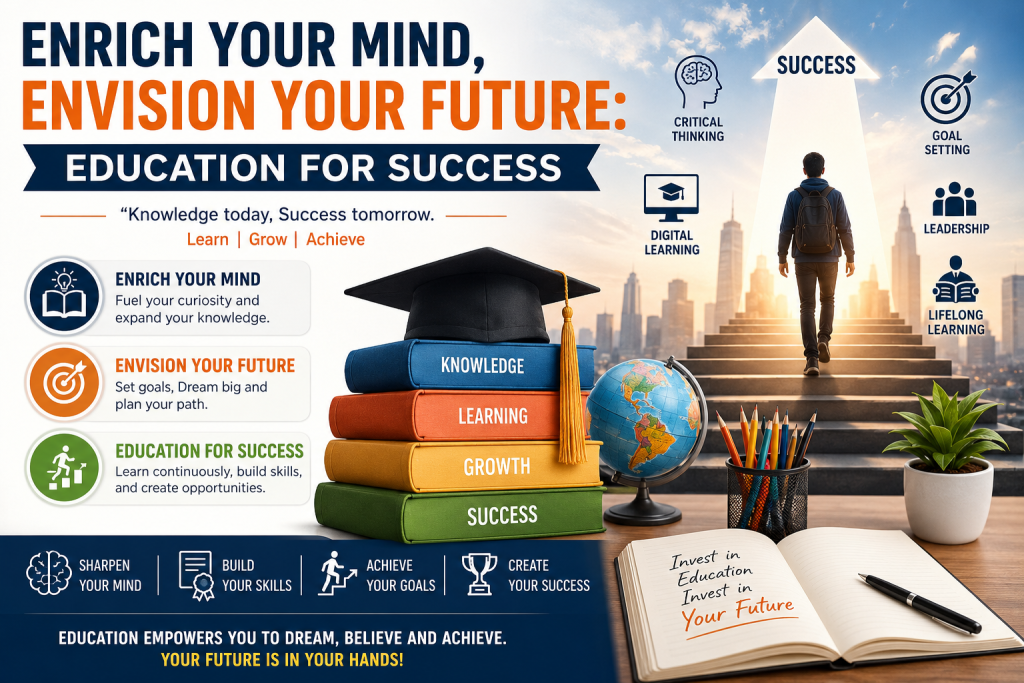
The phrase “Enrich Your Mind, Envision Your Future” captures the true purpose of education: expanding your knowledge while creating a clear vision for personal and professional success.
Why Education Matters
Education is one of the most powerful tools for personal transformation. It helps individuals:
- Develop critical thinking skills
- Improve communication abilities
- Build confidence and self-esteem
- Make informed decisions
- Adapt to technological advancements
- Achieve financial independence
- Become responsible global citizens
An educated mind is better equipped to identify opportunities, solve problems, and create innovative solutions.
Education Shapes Your Future
Every lesson learned today becomes a stepping stone toward tomorrow’s success. Education opens doors to countless opportunities including:
Better Career Opportunities
Employers value individuals with strong educational backgrounds because they possess problem-solving abilities, technical expertise, and professional ethics.
Financial Growth
Higher education and continuous skill development often lead to better-paying jobs and long-term financial stability.
Personal Development
Education teaches discipline, responsibility, time management, and emotional intelligence—qualities essential for success in every aspect of life.
Leadership Skills
Knowledge enables individuals to inspire others, make strategic decisions, and become effective leaders in their communities and organizations.
Learning Beyond the Classroom
Modern education is no longer limited to schools and universities. Digital transformation has made learning accessible from anywhere through:
- Online courses
- Virtual classrooms
- Educational YouTube channels
- Podcasts
- Webinars
- E-books
- AI-powered learning platforms
- Interactive mobile applications
Lifelong learning has become essential in today’s technology-driven world.
The Role of Technology in Education
Technology has revolutionized education by making learning more engaging, personalized, and accessible.
Some major innovations include:
- Artificial Intelligence (AI)
- Virtual Reality (VR)
- Augmented Reality (AR)
- Smart Classrooms
- Learning Management Systems (LMS)
- Cloud-Based Education Platforms
- Interactive Simulations
- Digital Libraries
Students can now learn at their own pace while educators gain powerful tools to improve teaching effectiveness.
Building Essential Skills for Success
Success in today’s world requires more than academic knowledge. Education helps develop:
Critical Thinking
Analyzing problems logically and making informed decisions.
Creativity
Finding innovative solutions and thinking beyond conventional approaches.
Communication
Expressing ideas effectively in both personal and professional environments.
Collaboration
Working efficiently with diverse teams to achieve common goals.
Adaptability
Responding confidently to technological and workplace changes.
Education and Personal Confidence
Knowledge builds confidence.
When individuals understand concepts, acquire skills, and achieve learning milestones, they become more confident in making decisions, solving challenges, and pursuing ambitious goals.
Confidence gained through education encourages people to:
- Start businesses
- Lead organizations
- Innovate
- Speak publicly
- Mentor others
- Continue lifelong learning
Lifelong Learning: The Key to Future Success
Education doesn’t end after graduation.
The most successful individuals continue learning throughout their lives by:
- Reading books
- Attending workshops
- Earning professional certifications
- Learning new technologies
- Following industry trends
- Networking with experts
Continuous learning keeps professionals relevant in competitive industries.
The Social Impact of Education
Education benefits not only individuals but entire communities.
It contributes to:
- Reduced poverty
- Improved healthcare awareness
- Gender equality
- Economic growth
- Technological innovation
- Environmental awareness
- Stronger democratic participation
- Social harmony
An educated society is better equipped to solve global challenges and create sustainable development.
How Students Can Maximize Their Education
To make the most of educational opportunities:
- Set clear learning goals.
- Stay curious and ask questions.
- Practice critical thinking.
- Learn digital and technical skills.
- Read beyond textbooks.
- Participate in extracurricular activities.
- Develop communication and leadership abilities.
- Embrace continuous learning.
- Learn from failures.
- Apply knowledge to real-world problems.
The Future of Education
The future of education will be shaped by innovation and personalization.
Emerging trends include:
- AI-powered personalized learning
- Adaptive assessments
- Immersive virtual classrooms
- Global collaborative learning
- Microlearning
- Skill-based certifications
- Blockchain credentials
- Data-driven education analytics
These advancements will make education more flexible, inclusive, and career-focused.
Conclusion
Education is the foundation upon which dreams are built and futures are shaped. It empowers individuals with knowledge, skills, confidence, and the vision needed to succeed in an ever-changing world. By embracing lifelong learning and leveraging modern educational technologies, anyone can unlock new opportunities and achieve lasting success.
Enrich your mind today, envision your future with confidence, and let education become the pathway to your greatest achievements.
Frequently Asked Questions (FAQs)
1. Why is education important for success?
Education provides knowledge, skills, confidence, and opportunities that help individuals achieve personal and professional goals.
2. How does education improve career opportunities?
It equips individuals with technical expertise, problem-solving abilities, communication skills, and professional qualifications valued by employers.
3. What is lifelong learning?
Lifelong learning is the continuous pursuit of knowledge and skills throughout life to remain adaptable and competitive.
4. How is technology changing education?
Technology enables personalized learning, online education, AI-powered tutoring, virtual classrooms, and global access to educational resources.
5. What skills should students develop for future success?
Students should focus on critical thinking, creativity, communication, collaboration, adaptability, digital literacy, and continuous learning.