
Data Governance and Analytics: How They Create a Strong Foundation for Better Business Decisions
In today’s digital economy, businesses generate massive amounts of data every second. From customer interactions and financial transactions to website traffic and employee performance, data has become one of the most valuable business assets. However, simply collecting data is not enough. To transform raw information into meaningful business value, organizations need two essential components: Data Governance and Data Analytics.
Together, these create a powerful framework that enables informed decision-making, regulatory compliance, operational efficiency, and long-term business growth.
What Is Data Governance?
Data Governance is the process of managing data through clearly defined policies, standards, responsibilities, and controls. It ensures that data is:
- Accurate
- Consistent
- Secure
- Reliable
- Accessible
- Compliant with regulations
Think of data governance as the rulebook that ensures everyone in an organization uses data correctly.
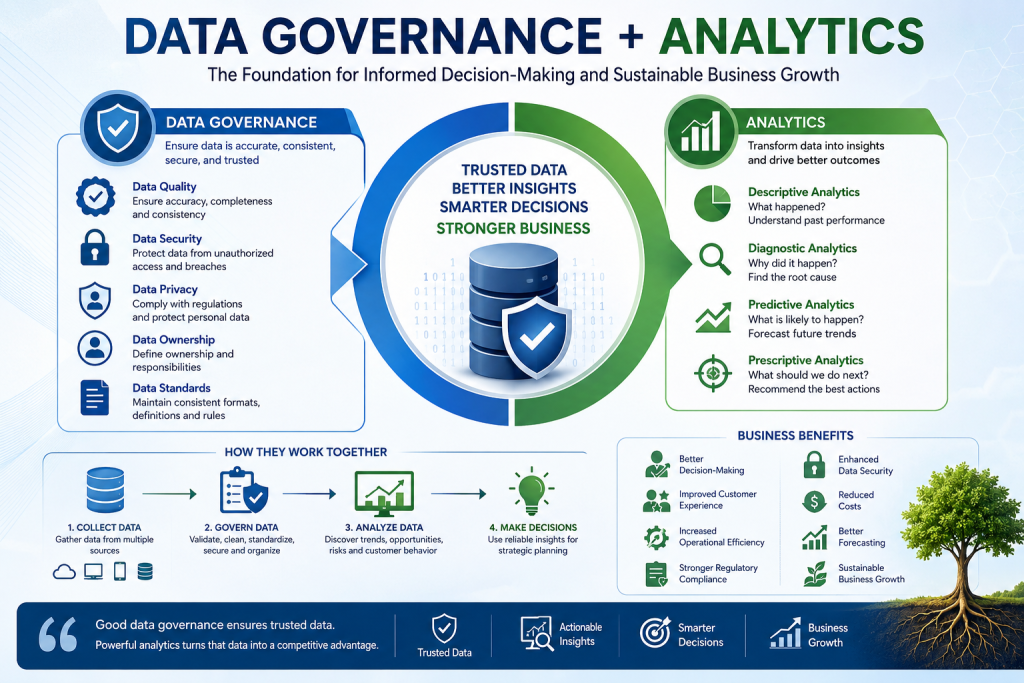
Key Components of Data Governance
1. Data Quality
Ensures that information is complete, accurate, and free from duplication.
2. Data Security
Protects sensitive business and customer information from unauthorized access.
3. Data Privacy
Ensures compliance with regulations like GDPR, HIPAA, and CCPA.
4. Data Ownership
Defines who is responsible for maintaining and approving datasets.
5. Data Standards
Maintains consistency across departments by defining common formats and naming conventions.
What Is Data Analytics?
Data Analytics is the process of examining data to discover patterns, trends, and insights that help businesses make better decisions.
Rather than relying on assumptions, analytics enables organizations to make evidence-based decisions backed by real data.
Types of Data Analytics
1. Descriptive Analytics
Answers:
What happened?
Example:
- Monthly sales reports
- Website visitor statistics
- Revenue dashboards
2. Diagnostic Analytics
Answers:
Why did it happen?
Example:
- Sales declined because website traffic dropped.
- Customer churn increased due to slower support response.
3. Predictive Analytics
Answers:
What is likely to happen?
Uses AI and Machine Learning to forecast future trends.
Examples:
- Sales forecasting
- Customer demand prediction
- Inventory planning
4. Prescriptive Analytics
Answers:
What should we do next?
Provides recommendations based on historical and predictive data.
Example:
- Suggesting optimal pricing
- Marketing campaign recommendations
- Route optimization
Why Data Governance Matters Before Analytics
Imagine analyzing inaccurate or duplicate data.
Even the most advanced AI tools will produce misleading insights if the underlying data is poor.
This is why organizations say:
“Good Analytics Starts with Good Data.”
Without governance:
- Duplicate records
- Missing values
- Incorrect reports
- Compliance risks
- Security breaches
become common business challenges.
How Data Governance and Analytics Work Together
Step 1: Collect Data
Gather information from:
- CRM
- ERP
- Websites
- Mobile Apps
- IoT Devices
- Databases
↓
Step 2: Govern Data
- Validate
- Clean
- Standardize
- Secure
- Organize
↓
Step 3: Analyze Data
Use BI tools and AI models to identify:
- Trends
- Opportunities
- Risks
- Customer behavior
↓
Step 4: Make Decisions
Leadership uses reliable insights for strategic planning.
Business Benefits
Better Decision-Making
Executives can make confident decisions using accurate, trusted data rather than intuition.
Improved Customer Experience
Analytics reveals:
- Customer preferences
- Purchase behavior
- Support issues
- Product recommendations
leading to personalized experiences.
Increased Operational Efficiency
Businesses can identify:
- Process bottlenecks
- Resource utilization
- Inventory optimization
- Workforce productivity
Stronger Regulatory Compliance
Governance ensures compliance with industry regulations while reducing legal and financial risks.
Enhanced Data Security
Proper governance minimizes risks related to:
- Data breaches
- Insider threats
- Unauthorized access
- Data loss
Reduced Costs
High-quality governed data reduces:
- Duplicate work
- Reporting errors
- Manual corrections
- Inefficient processes
Better Forecasting
Analytics helps organizations predict:
- Future sales
- Customer demand
- Market trends
- Financial performance
allowing proactive planning.
Real-World Example
Imagine an e-commerce company.
Without Data Governance:
- Customer records are duplicated.
- Product information is inconsistent.
- Sales reports contain errors.
- Marketing targets the wrong audience.
With Data Governance:
- Customer profiles are accurate.
- Inventory data is standardized.
- Product catalogs remain consistent.
- Sales reports become reliable.
Using Analytics:
- Best-selling products are identified.
- Customer buying behavior is analyzed.
- Demand is forecasted.
- Personalized recommendations increase conversions.
The result is higher revenue, lower costs, and improved customer satisfaction.
Best Practices for Implementing Data Governance and Analytics
- Establish clear data ownership.
- Define data quality standards.
- Implement robust security controls.
- Regularly audit and clean data.
- Create centralized data catalogs.
- Use Business Intelligence (BI) dashboards.
- Adopt AI and Machine Learning responsibly.
- Train employees on data literacy.
- Monitor KPIs continuously.
- Foster a data-driven culture across the organization.
Popular Tools
Data Governance
- Microsoft Purview
- Collibra
- Informatica
- Alation
- Talend
Data Analytics
- Microsoft Power BI
- Tableau
- Google Looker Studio
- Apache Spark
- Python (Pandas, Scikit-learn)
- SQL Server
- Snowflake
Common Challenges
Organizations often face:
- Data silos across departments
- Inconsistent data definitions
- Legacy systems
- Poor data quality
- Resistance to change
- Security and privacy concerns
- Lack of skilled professionals
Addressing these challenges requires executive support, well-defined governance policies, and the right technology.
The Future: AI-Powered Data Governance and Analytics
Artificial Intelligence is transforming both governance and analytics by enabling:
- Automated data quality checks
- Intelligent data classification
- Real-time anomaly detection
- Predictive governance
- Natural language querying
- AI-assisted decision support
- Self-service analytics
As organizations continue to embrace digital transformation, AI will play an increasingly important role in ensuring data remains trustworthy and actionable.
Conclusion
Data governance and analytics are no longer optional—they are essential pillars of a modern, data-driven organization. Data governance ensures that information is accurate, secure, and trustworthy, while analytics transforms that information into actionable insights. Together, they empower businesses to make informed decisions, improve operational efficiency, enhance customer experiences, and drive sustainable growth.
Organizations that invest in strong governance practices alongside advanced analytics capabilities are better equipped to navigate market changes, reduce risks, and unlock the full value of their data. In a world where data fuels innovation, combining governance with analytics is the key to smarter decisions and lasting business success.