
🧠 The Future of Software Development: How AI is Transforming the Development Lifecycle
Introduction
The world of software development is evolving faster than ever before, and Artificial Intelligence (AI) is at the forefront of this transformation. What was once a manual, time-intensive process of writing and debugging code is now being reshaped by AI-driven automation and intelligent tools. From AI-assisted coding to predictive analytics, the software development lifecycle (SDLC) is becoming smarter, faster, and more efficient.
In this article, we’ll explore how AI is revolutionizing the way developers build, test, and deploy applications, with examples, tools, and resources to understand this ongoing transformation.
1. AI-Powered Coding: From Autocomplete to Code Generation
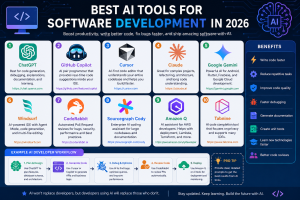
AI has made significant strides in assisting developers with code generation and error prevention. Tools like GitHub Copilot and ChatGPT’s Code Interpreter use large language models (LLMs) to understand natural language prompts and generate production-ready code snippets.
💡 Example:
If a developer wants to create a login page using React, they can simply type:
“Create a login form with email and password fields using React and Tailwind CSS.”
AI tools will instantly generate optimized, error-free code within seconds—saving hours of manual work.
📘 Recommended Tools:
2. Smarter Testing and Bug Detection
Testing is one of the most time-consuming phases in software development. AI-driven testing platforms now automate test case generation, predict potential defects, and even prioritize tests based on historical data.
For instance, Diffblue Cover automatically writes unit tests for Java applications using AI, while Testim.io leverages machine learning to adapt test scripts when UI changes occur.
💡 Example:
Instead of manually updating hundreds of test cases when a button changes its ID, AI tools detect and fix such changes automatically.
🔗 Learn More:
3. Predictive Analytics for Smarter Decision Making
AI doesn’t just react — it predicts. By analyzing past performance, user feedback, and release data, AI tools can forecast development bottlenecks, suggest feature improvements, and identify security vulnerabilities before they occur.
For example, Google’s AI for Code Review analyzes commit histories and predicts the likelihood of a bug being introduced by a particular code change. This helps teams proactively mitigate risks.
🔍 Explore More:
4. AI in Deployment and DevOps Automation
The combination of AI + DevOps (AIOps) has led to smarter CI/CD (Continuous Integration/Continuous Deployment) pipelines. AI models monitor server health, detect anomalies, and automatically roll back faulty deployments.
💡 Example:
AI-based platforms like Harness use machine learning to analyze deployment metrics and automatically optimize future rollouts—reducing downtime and improving reliability.
🔗 Check Out:
5. The Evolving Role of Developers
As AI becomes deeply integrated into the SDLC, the role of software developers is shifting from manual coding to strategic and creative problem-solving. Developers will spend less time fixing syntax errors and more time designing innovative solutions, integrating APIs, and managing AI-driven workflows.
AI won’t replace developers—it will empower them to focus on innovation, architecture, and business strategy.
💬 Industry Insight:
According to Gartner’s AI Engineering Report, over 80% of software development organizations will use AI-driven development tools by 2028.
6. Challenges and Ethical Considerations
While the benefits are immense, AI-driven development also introduces challenges such as:
- Data Privacy Risks (when training AI on sensitive codebases)
- Bias in Machine Learning Models
- Dependency on AI Suggestions
Developers and organizations must implement strict AI governance policies and use responsible AI frameworks such as Google’s Responsible AI Guidelines.
Conclusion
The integration of AI in software development is not just an innovation—it’s a revolution. By automating repetitive tasks, enhancing accuracy, and providing predictive insights, AI is enabling developers to focus on creativity, design, and innovation. As this synergy deepens, the future of coding will be more collaborative, intelligent, and efficient.
🚀 Whether you’re a beginner or a senior developer, now is the time to embrace AI tools and future-proof your development skills.
Related Articles
🔗 Top 10 AI Tools for Developers in 2025