
Introduction
In today’s competitive world, technology is no longer just a support function—it has become the foundation of successful businesses. Companies that embrace digital transformation are growing faster, serving customers better, reducing operational costs, and expanding into new markets with greater efficiency.
Whether you run a startup, a small business, or a large enterprise, investing in the right technology can dramatically improve productivity, profitability, and long-term sustainability.
This article explores how technology is transforming businesses, the latest innovations every company should adopt, and practical strategies to accelerate business growth.
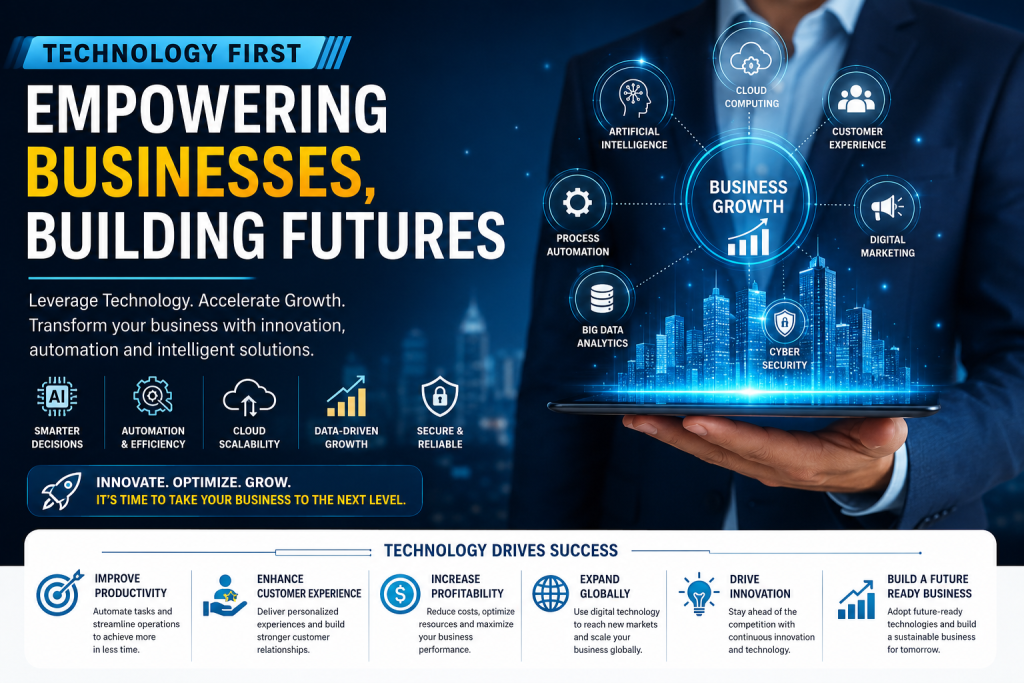
Technology drives business growth by helping companies automate operations, understand customers, make data-driven decisions, reduce costs, and scale efficiently. From AI and cloud computing to cybersecurity, analytics, CRM, and ERP systems, the right technology can create a stronger foundation for sustainable digital growth.
Quick Answer: How Does Technology Drive Business Growth?
Technology drives business growth by improving productivity, reducing operational costs, expanding customer reach, enabling faster decisions, and making business processes easier to scale. Companies can combine automation, AI, cloud computing, analytics, digital marketing, cybersecurity, CRM, and ERP solutions based on their specific growth goals.
Why Technology Should Be the First Priority
Many businesses still believe that growth comes primarily from increasing sales or hiring more employees. While these factors matter, modern business success begins with technology.
Technology enables businesses to:
- Automate repetitive work
- Reduce human errors
- Improve customer experience
- Make faster decisions through data
- Increase employee productivity
- Expand globally without opening physical offices
- Strengthen cybersecurity
- Reduce operational costs
Companies that adopt digital technologies early often outperform competitors who rely on traditional methods.
The Digital Transformation Era
Digital transformation means integrating technology into every aspect of business operations.
This includes:
- Cloud computing
- Artificial Intelligence (AI)
- Automation
- Mobile applications
- Business analytics
- Digital marketing
- Customer Relationship Management (CRM)
- Enterprise Resource Planning (ERP)
Businesses that successfully transform digitally become more agile, efficient, and customer-focused.
Artificial Intelligence (AI): The Future of Business
Artificial Intelligence is revolutionizing industries worldwide.
Businesses now use AI for:
Customer Support
AI-powered chatbots provide 24/7 customer assistance, reducing response time and improving customer satisfaction.
Data Analysis
AI processes millions of records within seconds, helping companies identify trends, predict customer behavior, and optimize business strategies.
Sales Prediction
Machine learning algorithms forecast future sales based on historical data, seasonal demand, and market trends.
Personalized Marketing
AI analyzes customer interests and delivers personalized advertisements, significantly improving conversion rates.
Fraud Detection
Banks, insurance companies, and e-commerce businesses use AI to detect suspicious activities in real time.
Automation Increases Productivity
Business automation eliminates repetitive manual tasks.
Examples include:
- Automatic invoice generation
- Payroll processing
- Inventory management
- Email marketing
- Lead nurturing
- Customer follow-ups
- Attendance systems
- HR onboarding
Automation saves time and allows employees to focus on higher-value work.
Cloud Computing Enables Unlimited Growth
Cloud technology removes the limitations of traditional IT infrastructure.
Benefits include:
- Access data from anywhere
- Lower infrastructure costs
- Easy scalability
- Better disaster recovery
- Secure data storage
- Automatic backups
- Remote team collaboration
Popular cloud platforms include Microsoft Azure, AWS, and Google Cloud.
Data Analytics: Making Smarter Business Decisions
Modern businesses generate vast amounts of data every day.
Business Intelligence (BI) tools transform this data into actionable insights.
With analytics, businesses can:
- Understand customer behavior
- Measure employee performance
- Identify profitable products
- Track marketing ROI
- Forecast future demand
- Monitor operational efficiency
Data-driven companies consistently make faster and more accurate decisions.
Cybersecurity Protects Business Growth
As businesses become more digital, cybersecurity becomes essential.
Cyber threats include:
- Ransomware
- Phishing attacks
- Data breaches
- Identity theft
- Malware
Businesses should invest in:
- Multi-factor authentication
- Data encryption
- Firewall protection
- Security monitoring
- Employee awareness training
- Regular backups
Strong cybersecurity protects both business reputation and customer trust.
Digital Marketing Expands Global Reach
Technology has transformed marketing into a measurable and scalable process.
Key digital marketing channels include:
- Search Engine Optimization (SEO)
- Google Ads
- Social Media Marketing
- Email Marketing
- Content Marketing
- Video Marketing
- Influencer Marketing
Unlike traditional advertising, digital marketing provides detailed analytics and measurable ROI.
Mobile Applications Improve Customer Engagement
Consumers expect businesses to be available on mobile devices.
Business mobile apps provide:
- Faster ordering
- Personalized offers
- Push notifications
- Loyalty programs
- Secure payments
- Customer support
A well-designed app enhances customer satisfaction and increases repeat business.
ERP Systems Streamline Business Operations
Enterprise Resource Planning (ERP) integrates all departments into a single system.
ERP manages:
- Finance
- HR
- Inventory
- Procurement
- Sales
- Customer Management
- Manufacturing
- Reporting
Integrated systems improve efficiency and reduce duplication of work.
Customer Relationship Management (CRM)
CRM software helps businesses manage customer interactions effectively.
Benefits include:
- Lead tracking
- Sales pipeline management
- Customer history
- Automated follow-ups
- Better customer retention
- Improved communication
Strong customer relationships lead to higher lifetime value.
Internet of Things (IoT)
IoT connects devices and machines through the internet.
Businesses use IoT for:
- Smart manufacturing
- Predictive maintenance
- Fleet tracking
- Energy management
- Healthcare monitoring
- Agriculture automation
IoT provides real-time monitoring and improves operational efficiency.
Blockchain Technology
Blockchain improves transparency and security.
Business applications include:
- Supply chain management
- Digital identity
- Smart contracts
- Financial transactions
- Healthcare records
Blockchain reduces fraud and increases trust among stakeholders.
Remote Work Technology
Hybrid and remote work have become standard for many organizations.
Technology enables remote collaboration through:
- Video conferencing
- Project management tools
- Cloud storage
- Team messaging
- Digital document signing
Remote work reduces operational costs while expanding access to global talent.
Technology-Driven Customer Experience
Today’s customers expect:
- Instant responses
- Personalized recommendations
- Secure payments
- Fast delivery
- Seamless online experiences
Businesses that invest in customer experience technology build stronger loyalty and increase repeat purchases.
Emerging Technologies to Watch
Businesses should prepare for the next wave of innovation:
- Generative AI
- AI Agents
- Robotics
- Edge Computing
- Digital Twins
- Extended Reality (XR)
- 5G Connectivity
- Quantum Computing
- Autonomous Systems
Early adoption of these technologies can create a significant competitive advantage.
Practical Strategies for Technology-Driven Business Growth
To maximize business development through technology:
- Develop a clear digital transformation roadmap.
- Automate repetitive processes wherever possible.
- Invest in AI and analytics for informed decision-making.
- Migrate critical systems to the cloud.
- Prioritize cybersecurity at every level.
- Strengthen your online presence with SEO and digital marketing.
- Build customer-focused mobile and web applications.
- Train employees continuously on new technologies.
- Use CRM and ERP systems to integrate business operations.
- Continuously measure performance using data and KPIs.
Benefits of Technology-Led Business Development
Organizations that prioritize technology typically achieve:
- Higher productivity
- Lower operational costs
- Faster decision-making
- Increased revenue
- Better customer satisfaction
- Improved employee efficiency
- Stronger security
- Greater scalability
- Enhanced innovation
- Long-term competitive advantage
Related Technology and Business Guides
- AI Agents in 2026: What Are AI Agents and How Do They Work? — learn how AI agents can support modern business automation.
- Best AI Tools for Software Development in 2026 — explore practical AI tools for technology-driven teams.
- Security Audit of Software Projects — strengthen security as your business and technology stack grows.
Conclusion
Technology is no longer optional—it is the engine that powers modern business success. From Artificial Intelligence and cloud computing to automation, cybersecurity, and data analytics, every technological advancement offers businesses new opportunities to grow, innovate, and compete.
Organizations that place technology at the center of their strategy are better equipped to adapt to changing markets, exceed customer expectations, and build sustainable long-term growth. Investing in technology today is not just about improving operations—it’s about creating a resilient, future-ready business capable of leading tomorrow’s digital economy.